


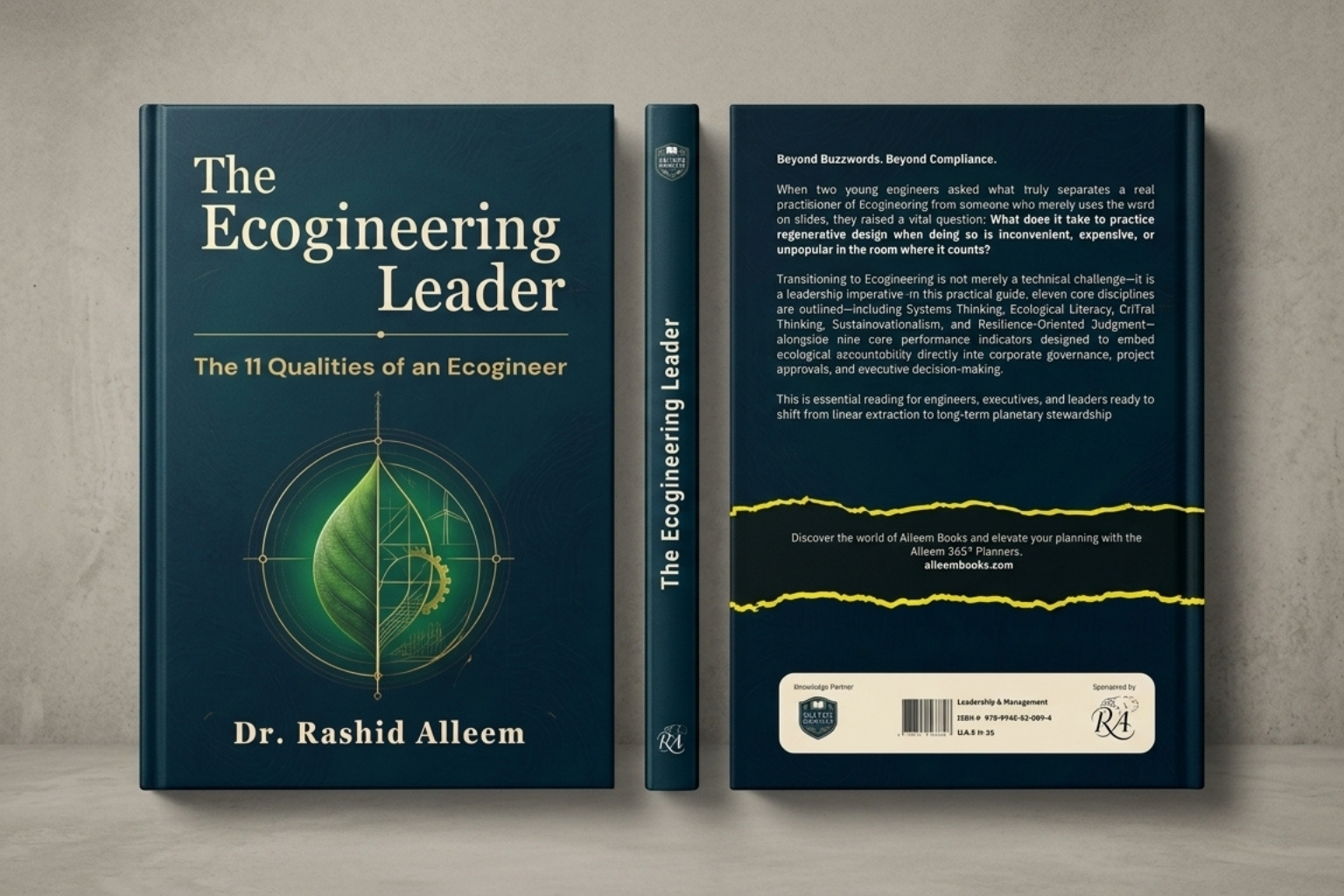
A forward-thinking leadership framework that unites ecology and engineering to inspire regenerative innovation, responsible decision-making, and a more sustainable future.
Sustainability is no longer just about reducing environmental damage. The Ecogineering Leader: The 11 Qualities of an Ecogineer challenges leaders to design systems that actively restore ecosystems, strengthen communities, and create lasting value.
Written by Dr. Rashid Alleem, this book introduces Ecogineering, the intentional combination of ecology and engineering, and explores the leadership mindset required to transform sustainability from a corporate promise into measurable organizational action.
Regenerative Leadership • Sustainability • Ecological Innovation
The 11 Qualities of an Ecogineer: Redefining modern leadership through ecology, engineering, and regenerative thinking.
Written by Dr. Rashid Alleem
What if the future of leadership was not simply about minimizing environmental damage, but actively restoring the ecosystems upon which our societies, industries, and economies depend?
In The Ecogineering Leader: The 11 Qualities of an Ecogineer, UAE-based executive, author, and global sustainability architect Dr. Rashid Alleem presents a new approach to 21st-century leadership.
Introducing the concept of Ecogineering, the book brings together ecological responsibility, engineering principles, and human-centered leadership to explore how technological, industrial, and social systems can create positive environmental and societal outcomes.
More than a discussion of sustainability, this book connects the personal qualities required of leaders with the practical performance measures needed to build a regenerative future.
Coined by Dr. Rashid Alleem at the 10th Sustainable Development Week in 2026, Ecogineering represents the intentional synthesis of ecology and engineering.
It is an approach to designing and managing technological, industrial, and social systems that go beyond reducing environmental harm to actively restoring and strengthening the living ecosystems they inhabit.
Ecology: Recognize the importance of living ecosystems, biodiversity, natural resources, and the interconnected environmental systems that support life.
Engineering: Apply intentional design, practical innovation, and structured systems thinking to address complex industrial, technological, and social challenges.
Regeneration: Move beyond minimizing damage by designing systems that contribute to ecological restoration, resilience, and long-term sustainability.
The idea behind this leadership framework emerged from conversations with two working engineers, Obaid and Hind, who raised an important concern about modern sustainability practices.
Although sustainability had become a familiar term in corporate presentations and organizational strategies, institutions rarely examined the personal qualities required of the leaders responsible for putting those commitments into practice.
This observation helped shape the central philosophy of The Ecogineering Leader: meaningful environmental progress requires more than policies, targets, and technology. It also requires leaders whose values, decisions, and actions support regenerative outcomes.
At the heart of the book is an exploration of the 11 qualities of an Ecogineer, emphasizing the personal dimension of leadership in an increasingly complex environmental and industrial landscape.
Rather than treating sustainability as an isolated corporate function, the book encourages leaders to consider how their character, values, decisions, and operational responsibilities contribute to ecological and organizational outcomes.
The Leadership Mindset: Explore why the personal qualities of decision-makers are essential to transforming environmental commitments into meaningful action.
The Moral Compass: Understand the importance of connecting leadership decisions with ecological responsibility, human well-being, and long-term consequences.
The Operational Methodology: Discover how leadership principles can be connected to measurable indicators, organizational processes, and accountability systems.
One of the central challenges addressed in this book is how organizations can prevent Ecogineering from becoming another compliance dashboard or corporate values statement that disappears when financial trade-offs arise.
Dr. Rashid Alleem emphasizes the importance of integrating environmental and social performance directly into the mechanisms that shape organizational decisions.
To translate Ecogineering into practical organizational action, the book outlines nine Core Performance Indicators (CPIs) designed to connect regenerative principles with executive decisions, procurement policies, and project approvals.
Long-Term Ecological Impact: Measure the health trajectory of ecosystems throughout a project's lifecycle in comparison with its original environmental baseline.
Resource Efficiency & Material Recovery: Evaluate the percentage of circular material inputs and the recovery of resources at the end of their useful life.
Carbon Reduction & Removal: Track carbon emissions reduction and carbon removal as two separate metrics to maintain clarity and accuracy in environmental measurement.
Water Conservation & Watershed Health: Monitor net water consumption in relation to local aquifer recharge and the health of surrounding water systems.
Biodiversity Enhancement: Measure improvements in species diversity, habitat connectivity, and positive ecological outcomes.
Employee Well-Being & Retention: Recognize workforce well-being and employee retention as important leading indicators of operational resilience.
Community Benefit & Social Resilience: Evaluate how organizational activities contribute to strengthening local communities and their ability to withstand disruption.
Product Durability & Repairability: Assess designed product lifespan, modular repairability, and ease of disassembly to support more responsible product development.
Organizational Adaptive Capacity: Test system redundancy and the organization's practical ability to absorb unexpected shocks and maintain resilience.
The Ecogineering approach encourages organizations to reconsider how leadership, engineering decisions, environmental performance, and social responsibilities are connected.
Its nine performance indicators provide a foundation for examining both ecological outcomes and the resilience of the people and systems involved.
Introduces Ecogineering, a concept coined by Dr. Rashid Alleem at the 10th Sustainable Development Week in 2026.
Explores the intentional synthesis of ecology and engineering as a foundation for regenerative systems.
Focuses on the personal qualities required of leaders responsible for making sustainability commitments meaningful.
Outlines nine measurable Core Performance Indicators connecting ecological responsibility with organizational accountability.
Advocates embedding regenerative performance measures into executive compensation, procurement rules, and project approvals.
The Ecogineering Leader offers valuable insights for individuals responsible for shaping organizations, technological systems, environmental strategies, and long-term societal outcomes.
Discover a new perspective on leadership that unites ecological responsibility, engineering innovation, and measurable accountability. Order The Ecogineering Leader: The 11 Qualities of an Ecogineer by Dr. Rashid Alleem and explore how regenerative thinking can shape stronger organizations, healthier ecosystems, and a more resilient future.